The University of Tokyo’s carbon cycle assessment model, VISIT, and NEC’s data assimilation technology calculate decarbonization effect in forests with greater efficiency and accuracy than conventional methods
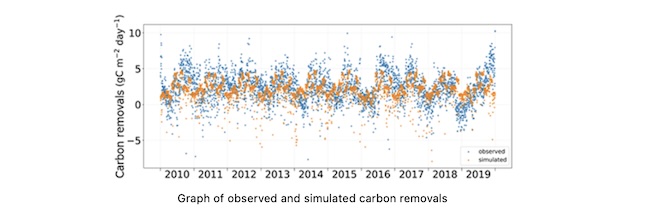
TOKYO, Mar 12, 2026 - (JCN Newswire) - The University of Tokyo’s Graduate School of Agricultural and Life Sciences, Faculty of Agriculture, and NEC have calculated carbon accumulation rates for Lambir Hills National Park in Malaysia based on observed removals data for greenhouse gases (GHG) utilizing the university’s VISIT (Vegetation Integrated SImulator for Trace gases) terrestrial ecosystem model.
NEC’s data assimilation technology (patent pending) was used to correct data errors, and observed data was compared with simulated data in order to calculate carbon accumulation rates with a high degree of accuracy, achieving a daily margin of error of 9.4%.
Background
NEC is promoting initiatives to quantify GHG removals in forests across Southeast Asia and to develop carbon credits in the forest sector. As part of these efforts, NEC has been conducting joint research with the Graduate School of Agricultural and Life Sciences at The University of Tokyo, which developed the VISIT model, an ecosystem model with strengths estimating carbon stocks and fluxes (*1) in forests in the Asian region.
The VISIT model estimates carbon stocks and fluxes based on forest vegetation, soil, and meteorological data. By combining VISIT with NEC’s data assimilation technology, exceptionally high-precision estimation of forest carbon accumulation rates has become possible.
Data assimilation technology is a computational method that improves model accuracy by adjusting model parameters based on differences between model outputs and observed data. NEC’s data assimilation technology is designed to enhance the accuracy of carbon flux estimations for the future by linking VISIT with image data obtained from satellite-mounted sensors. A patent application has been filed by NEC for this technology.
Key features of the VISIT model
The VISIT model assesses carbon cycles in terrestrial ecosystems. In addition to enabling estimation of carbon stocks and fluxes using vegetation, soil, and meteorological data, the model can also assess the impacts of land-use changes and climate change. VISIT is particularly well suited for improving accuracy based on observed data and is regarded as highly reliable compared with other similar models.
Furthermore, the VISIT model is applicable to forests across Asia, including Japan. The methodologies recommended by the Verified Carbon Standard (VCS), the world’s largest voluntary carbon crediting program, primarily reference models developed for Europe and North America and have not specified models tailored to Asian regions (*2). This joint research utilizing the VISIT model is expected to make important contributions to the advancement of forest carbon credit development in Asia.
Key features of data assimilation
Data assimilation is a computational method that improves the accuracy of model estimation by correcting model parameters based on differences between model outputs and observed data. The NEC data assimilation technology used in this joint research has the potential, in the future, to enhance the accuracy of carbon flux estimation by linking the VISIT model with satellite-mounted hyperspectral sensors. A patent application has been filed by NEC for this technology.
Currently, the application of data assimilation technology to observational models in the forestry field is not widespread. By applying this technology to the VISIT model, more efficient and highly accurate data collection in forest environments becomes possible, contributing to the advancement of forest conservation initiatives.
Building on the findings obtained through this joint research, NEC will accelerate its initiatives in natural capital accounting and carbon credit development.
(1) The amount of carbon dioxide absorbed and emitted between forests and the atmosphere.
(2) Source: Verra, a nonprofit organization that operates standards in environmental and social markets.
About NEC
The NEC Group leverages technology to create social value and promote a more sustainable world where everyone has the chance to reach their full potential. NEC Corporation was established in 1899. Today, the NEC Group’s approximately 110,000 employees utilize world-leading AI, security, and communications technologies to solve the most pressing needs of customers and society.For more information, please visit https://www.nec.com,
Topic: Press release summary
Source: NEC Corporation / University of Tokyo
Sectors: Environment, ESG
https://www.acnnewswire.com
From the Asia Corporate News Network
Copyright © 2026 ACN Newswire. All rights reserved. A division of Asia Corporate News Network.
|